Today, I want to share about some of the online communities I’ve been part of throughout my life. There have been quite a few, but two stand out as my homes on the net.
Active Worlds
First, there’s Active Worlds, or AW as most of us call it. It’s a 3D sandbox where you can build cities and worlds, and socialize with others. Active Worlds has been around since about 1995, providing a virtual space for creativity and connection. In Active Worlds, I go by the name Dovestar. I’ve built a few cities and created around seven different worlds. For quite a few years, I also hosted parties within the AW universe with a live DJ. Over the years, I’ve made many friends in Active Worlds. Sadly, I’ve lost some to death and others have left AW for various reasons. Like any community, it has had its drama, but in the long run, it has been a pleasure being part of that community for 28 years of my life so far.
EVE Online
The other is EVE Online, a space-based game that I believe has been around since about 2007. EVE offers a vast array of activities, from industry and mining to PvE and PvP battles. You can join or create Corporations and Alliances, making it a complex and often dramatic online community, much like any other. In EVE Online, my main character is named Nomad Ratsevod. I’ve made a lot of friends through the corporations and the alliance I’m part of. The game has its fair share of drama, but considering it includes pirate-like mentalities and warfare, it’s expected. You gain allies and enemies within the game, sometimes just to be content for another alliance or corporation, and individual players too.
So far, I am proud to be a part of both these communities and enjoy the gameplay along with the socialization within both. If you find yourself in either of these games, feel free to add me as a friend and send me a message.
In the vast expanse of the cosmos, humanity has long pondered the existence of extraterrestrial life and unidentified flying objects (UFOs), now more formally known as unidentified anomalous phenomena (UAPs). The intrigue surrounding these mysterious sightings has been matched only by the skepticism and secrecy often associated with governmental handling of such information. This article delves into the documented instances of potential concealment by the U.S. government, shedding light on the intricate dance between transparency and secrecy.
Adding to the controversy, whistleblowers have accused the U.S. government of hiding alien bodies3. These claims, while sensational, have yet to be substantiated with concrete evidence, leaving the public to wonder about the veracity of such assertions.
The intersection of UFOs, UAPs, and government secrecy is a complex web of intrigue and mystery. While documented examples of concealment exist, the full extent of the government’s knowledge and its reasons for secrecy remain shrouded in ambiguity. As society continues to seek answers, the balance between national security and the public’s curiosity hangs in a delicate balance.
I have often wondered if we are alone in the universe or if there is life somewhere else. Space is so huge and varied, with many stars and planets that could support life in the right conditions. Maybe there is a civilization out there that is much older and more advanced than ours, or maybe only simple microbes and cells exist beyond our solar system.
My opinion is that we are not the only intelligent beings in the universe. There could be both more and less advanced races than us, depending on how long they have existed. I think the universe would be too empty if only one sentient species were inhabiting it. It makes more sense to have a diversity of species throughout the universe to spread and sustain life.
I don’t rule out the possibility that extraterrestrials have visited Earth and influenced our ancestors, but there is no clear evidence for that yet. I know that traveling across vast distances of space from another star system is beyond our current science and technology, but some older and more advanced races may have discovered ways to fold space, warp space, or use wormholes to shorten the travel time.
The Ancient Alien theory doesn’t resonate with me when it suggests that humans required alien support to build enormous structures and so on. That’s undervaluing human ingenuity and talents. Some ancient constructions are still amazing and challenging to reproduce with today’s technology, but that is not proof that some extraterrestrial species were involved in their creation.
The U.S. Government has recognized the existence of UAPs (previously called UFOs) and some of them have shown abilities beyond our current technology. This has cleared the way for the topic to be explored without stigma. This enables more serious scientific inquiry and open conversation on the phenomenon without the academic and social stigma that used to hinder it.
Many UFO enthusiasts and conspiracy theorists wonder if governments around the world have alien technology or contact and are keeping it secret from the public. If that is the case, I wouldn’t be shocked and I would think that revealing that they have been hiding that from the public would be something difficult for them to do without causing some kind of social turmoil or political fallout.
Sooner or later, the truth always emerges no matter how much they try to conceal it from the public. So they will probably try to find a way to disclose most of the truth but in a way to minimize the political and social repercussions of hiding the truth for so long. But as I said before, this is all speculation and theory when it comes to the possibility of the governments hiding the truth of their possession of alien spacecraft and technology or possible contact with such extraterrestrial beings.
I wish that if there are Extraterrestrial visitations and technology that our governments are hiding, that they will be revealed and found within my lifetime. Far as the religions of the world, I don’t think the discovery that we are not alone in the universe would cause any problems. Instead, I think it would just reinforce their belief and faith.
In conclusion, I have shared my thoughts and opinions on the possibility of life in the universe, the existence of UAPs, and the potential cover-up of alien technology and contact by the governments. I have also expressed my hope and curiosity to learn the truth in my lifetime, and my view on how the religions of the world would react to such a discovery. These are all speculative and theoretical topics, but they are fascinating and intriguing to explore.
Thank you for reading my blog post on the possibility of life in the universe and the mystery of UAPs. I’m curious to know your thoughts and feedback on this topic. Do you share or differ from my opinions? Do you have any queries or tips for me? Please don’t hesitate to leave a comment below and share your views. I appreciate your time and interest.
An open mind is a mind that is not frozen in preconceived beliefs.
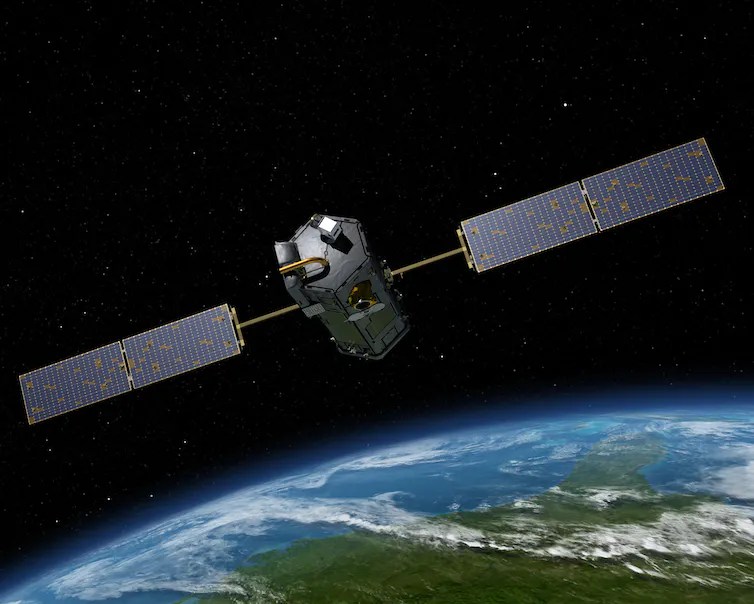
NASA’s Orbiting Carbon Observatory (OCO-2) satellite can make precise measurements of global atmospheric carbon dioxide (CO2) from space. (NASA/JPL-Caltech)
The central objective of the Paris Agreement is to limit Earth’s warming to well below 2 C above pre-industrial levels, but preferably 1.5 C.
This challenging task will require policies and tools to enable every sector of society to drastically reduce greenhouse gas (GHG) emissions to eventually reach net-zero.
Enacting the most effective and efficient strategies to reduce emissions starts with knowing in detail where, when and how much of these greenhouse gases we are emitting, followed by implementing emission reduction policies and tracking our progress.
Is it possible to track carbon dioxide (CO2) emissions and emission reductions from space? New research from my group shows that it is.
Why CO2 matters
CO2 is the primary greenhouse gas driving climate change. Burning fossil fuels for electricity generation, heating buildings, industry and transportation has elevated the CO2 in our atmosphere well beyond natural levels.
Currently, CO2 emission reporting is mainly done by accounting for the mass of fossil fuels purchased and used, then calculating the expected emissions — not actual atmospheric CO2 measurements. The finer details about exactly when and where the emissions occurred are often not available, but more transparent monitoring of CO2 emissions could help track the effectiveness of policies to reduce emissions.
Today GPS satellites help us to get around, meteorological satellites track weather systems and communication satellites relay TV, internet and telephone signals. It is time we use satellites to help tackle the biggest challenge that humanity has ever faced — climate change.
Satellites can observe the entire planet. Those that measure CO2 in the lower atmosphere near Earth’s surface (where CO2 emissions and CO2 uptake by plants happens) first began making measurements in 2002. Since then, they have been getting better and better at doing it, but there have been setbacks along the way.
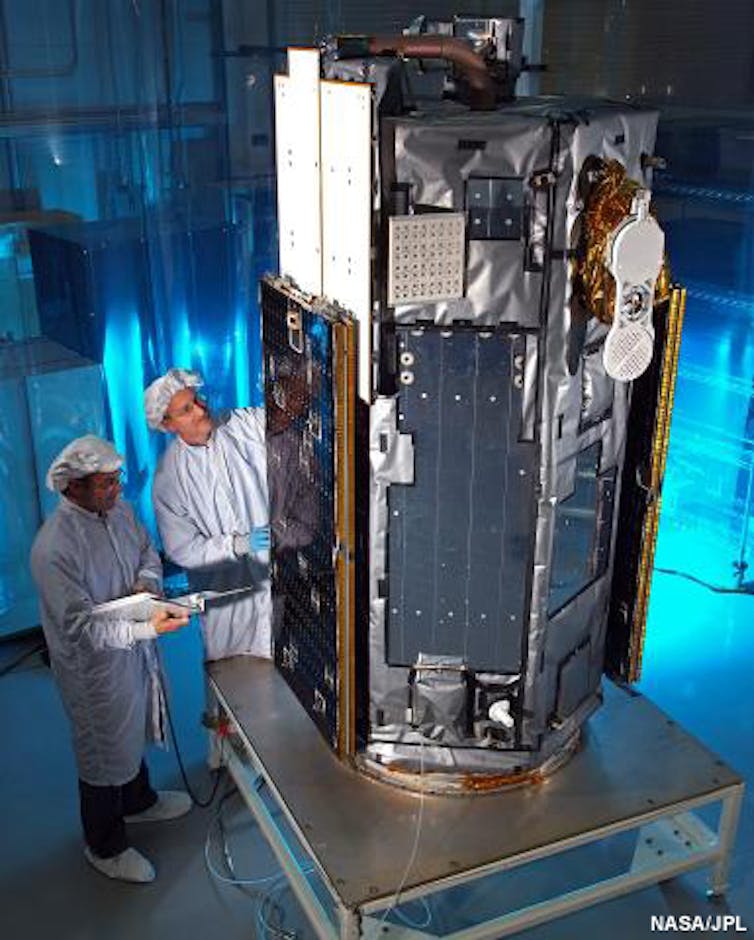
About a decade of effort by NASA went into developing the Orbiting Carbon Observatory (OCO) satellite to make precise measurements of atmospheric CO2 across the Earth.
NASA developed the Orbiting Carbon Observatory satellite to make precise measurements of atmospheric CO2 across the Earth. (NASA/JPL), Author provided
In 2009, OCO was lost due to a launch problem. After sustained advocacy for a rebuild of this important climate mission, NASA secured new funding to launch the OCO-2 satellite in 2014 and OCO-3 to the International Space Station in 2019.
The OCO missions were designed to improve our understanding of vegetation’s CO2 absorption, also known as the land carbon sink. But what about fossil fuel CO2 emissions?
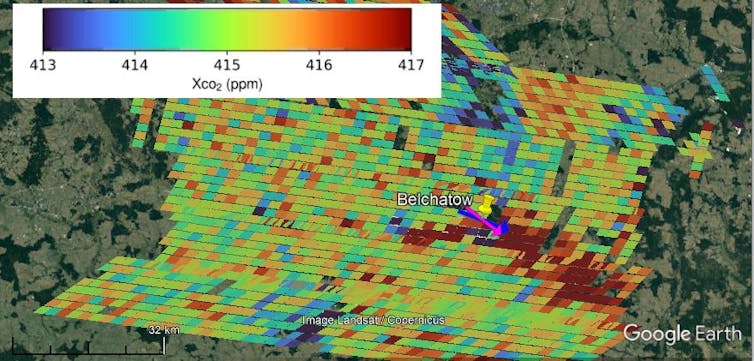
OCO-3 is very similar to OCO-2, but has an additional pointing mirror that enables it to better map CO2 around targets of interest like the Bełchatów Power Station in Poland, Europe’s largest fossil fuel burning power plant and CO2 source.
Bełchatów Power Station, Europe’s largest fossil fuel burning power plant. (Shutterstock)
With ten clear views of CO2 emission plumes from Bełchatów imaged by OCO-2 and OCO-3 from 2017-2022 analyzed in our new study, we were able to determine emissions on those days.
European power plants report hourly power generation but only annual CO2 emissions. Power generation fluctuates with electricity demand and generating unit shutdowns (for maintenance or decommissioning) and CO2 emissions are expected to exhibit proportional fluctuations.
We confirmed this using OCO-2 and OCO-3 in our recent paper, which showed that satellite observations can track changes in facility-level CO2 emissions. This means that satellites can be used to verify (or refute) reported CO2 emission reductions that result from climate change mitigation — like mandated efficiency improvements, carbon capture and storage technology, etc.
A plume of high CO2 resulting from coal burning is evident down wind from the Bełchatów Power Station in OCO-3 observations. (Ray Nassar), Author provided
Emissions monitoring for the Paris Agreement
Our approach can be applied to more power plants or modified for CO2 emissions from cities or countries with OCO-2 and OCO-3. We can also try integrating the satellite observations with CO2 monitoring from the ground or aircraft.
While we are already working on this, advances will only be incremental until the launch of the European Commission-funded Copernicus Anthropogenic CO2 Monitoring Mission or “CO2M”. CO2M is comprised of two satellites, aiming to launch in late 2025.
Hopefully, with new, more detailed and transparent tracking of human-caused greenhouse gas emissions to assess and guide us toward the most effective policies, society can achieve the emission reductions needed to reach net-zero in time.
Ray Nassar, Research Scientist at Environment and Climate Change Canada (ECCC), Adjunct Professor in Atmospheric Physics, University of Toronto
This year there has a been a twist in the Pro’s and Internet Radio Broadcasters story. The once Reliable and Affordable Licensing company named Stream Licensing stopped paying ASCAP and there has been talk of them not reporting info to other PROs such as B.M.I.and Sound exchange. They claim the ASCAP issue is due to overpayment and they stopped paying them due to such, to me this is irresponsible and is a disservice to the clients they represent. They are Doing some nice dodging and weaving through emails promising things that are not realistic such as buying a radio station which they owned for some time prior and that is not licensed and talking about ownership options etc.
I have read a post stating a former SL client filing complaints to the Law officials in Florida and some complaints possibly going to the FCC as well about the situation. Do I think Streamlicensing.com part of Stardom Media is being fraudulent? I can not tell you since there is always more to the story than you can find. But I do find it quite unethical to not pay the ASCAP fees and not let us know when they began doing so, they waited almost 6 to 8 months before notifying us and it was mainly due to ASCAP sending out emails.
Ok That said at the moment I would suggest avoiding SL until they get their records and licensing in order. This only leaves most of us hobbyists with a few options, paying ascap directly and forking out 200+ dollars.(outside of my budget) Moving to live365.com and be very restricted far as how you can listen to the music (all web based no direct link for Media Players etc.) and pay about the same amount and have to go with their broadcast servers, Radionomy which is a pain to keep going and you must meet quotas to keep the station up along with they are only web based or app. based in the USA. Then the next to last option of playing only Creative Commons Music, which I love but it limits what listener base you will receive.
The only 2 options left are Closing down the Station or go through the painstaking process of contacting each record company, artists etc. to get a waiver to play their music. Their may be many artists who would sign waivers to keep their exposure up via the internet streaming since mainstream radio stations don’t play them often since they are not the popular bands or of the popular genres.
The thing is I went legal out of my desire to not only be legit but to support those artists, songwriters etc. they do deserve money for their works, but the amount that we must pay in internet streaming is quite high, and since advertisers are not too willing to support internet streams unless they are owned by some big media corp. etc. it makes it hard to even make any revenue to offset the cost of playing the music we all love.
I think one thing that really makes me mad is how many PRO’s there is and how complicated it is to get covered and to be legal, you would think that they would get together and form a one stop shop for licensing and make it affordable and a monthly payment. They would have more on board being legal for one thing and they wouldn’t have issues like they are at the moment with such places like Stream Licensing.
Now I Call out for Artists, Songwriters, Composers and Record companies to get into the game and try to find a solution that can help the broadcasters within the new media category become the new way to get artists exposure and raise capitol along with making it an affordable venture for the small broadcasters. There must be some way all the PRO’s and those associated with the Music industry can work together and find a way to make it good for all of us involved.
I really Hope Stream Licensing gets their act together and do what is right by their clients, after this month I may just move on to live365, play Creative Commons Licensed music or Even kill the station . Sad But its a Fact of life when your just a guppy in a ocean of sharks and whales I guess.
Feel free to leave comments on the Stream Licensing situation as well as the options out there for the little guppy broadcasters 😀
Have you ever find it hard to understand and know the impulse of the majority? Let’s say you have a study or you just simply need to know what people actually like or not.
If you have been pondering or searching for ways to get a quick result from surveying a certain group or your readers, I have something to recommend for you.
It’s simple, hassle-free, and will provide a surely quick result. Still, as technology continues to improve our daily lives, we can use an online poll to quickly understand and get the voice of the majority.
And for you to create an effective, stylish and eye-catching online poll, you can generate it through Apeo which guarantee a user-friendly experience of generating polls to suit your subject or audience.
You can generate an online poll through their site or download their iOS app.
The following are the simple and easy steps to generate poll:
Apeo allows you to ask your readers anything and get a quick feedback from your on-going platforms simultaneously while giving you the choice between spreading the word and a more targeted approach. The answers are anonymous so you know you’re getting them right. You can quickly discover the majority’s viewpoint on a certain issue and learn how your readers/followers view and feel on any given topic.
Here is the sample of online poll made through Apeo:
Starting your own internet radio station is pretty simple now days and there are several ways to do so. You can broadcast directly from your pc using shoutcast and winamp, pay for a shoutcast server with a auto DJ and last but not least you can create a free account at radionomy.
In future posts I shall cover more of the other methods of starting a internet radio station, in this post I am going to focus on radionomy. Radionomy is not only a free way to start r listen to internet radio, Radionomy is now the owner of Shoutcast and Winamp. For a free platform they provide a pretty good scheduling system within their radio manager. You can upload 1000 files to start with for you radio and they also have music available from their own catalog . The best part is Radionomy takes responsibility for the licensing required to be a legal broadcast. That’s right no worries about the copyright police knocking on your door.
“Radionomy is a free groundbreaking platform that is changing the way people from around the world create, discover, and listen to Internet radio. Radionomy provides everyone from artist and celebrities to professional broadcasters and music lovers with the tools and infrastructure to create, broadcast, promote and monetize their own online radio stations completely free of charge”









 One Lifetime Blog
You must be logged in to post a comment.